On May 27, 2026, we held the SIGCHI Finland spring seminar, “The new mundane – everyday futures” in which we had the pleasure of listening to Martina Čaić, Sérgio Tavares, and Jane Vita. The presentations had an underlying current on the changing roles and significance of humans in the socio-technical landscape. The strong weak signals of determinism are evident with the accelerated evolution of humans who are fast moving into the background as AI feeders, who carry responsibility of the machines without the time to really think through the consequences, and perhaps to avoid the problems in the first place.
We listened to the results of a longitudinal study of chatbots in service work conducted by Martina and colleagues, Katja Einola, Violetta Khoreva, Janne Tienari, and Robert Ciuchita, who showed the simultaneous fading of human presence in the service industry, while chatbots themselves become anti-anthropomorphised and more ‘universal’. The differences in experiences and opinions between service professionals and backend chatbot developers at this point in time are significant. While service professionals are fading into the background – from highly visible in 2017 to data analysts 2024 onwards – ‘content orchestrators’ have been confident in their experience of AI as a necessary co-worker. Yet, as time goes on, and ‘content orchestrators’ are less needed, how will they feel about their ‘co-workers’?
Sérgio presented a hypothetical course comprising six units focused on skills needed in a time of “known unknowns” and “unknown unknowns.” I strongly recommend his pedagogical approach, particularly based on our (University of Vaasa) students’ experiences. He emphasised that such courses should prioritise the planning process, rather than treating the project outcome as the final goal. This raises important questions about when we should “freeze, upgrade, or delete.”
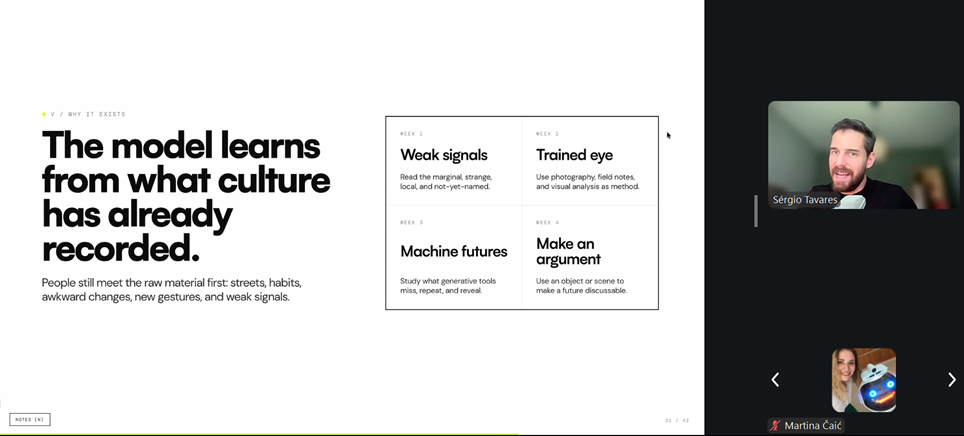
He also noted that “the machine should not end the conversation – it should improve it.” This is particularly relevant when considering how conversation itself is being shaped. For example, Google is now offering courses on culture and on art and design movements such as Bauhaus, recognising that people need to understand what constitutes a “style.”
Culture (or art + design more broadly) has always played a strategic role in society, either reinforcing dominant trajectories and hegemonies or challenging them through anti-establishment movements. It is therefore worth reflecting on which movements are being promoted, and how, by large companies, educational institutions and governments in relation to AI. What does this reveal about the intentionality and underlying ideologies of our socio-technical systems?
Then Jane began her talk by asking, “When was the last time you were truly bored?” This certainly made us think – what a great question – ideas poured into the chat about boredom’s luxury status and commercialisation possibilities. She also drew our attention to Hartmut Rosa who notes that “[t]he most important technologies today are often the ones we stop noticing” and of course, how we stop noticing the ways in which they impact the way we live (and work). Jane emphasised that optimisation is not neutral. Conditions for the deepest thinking are the conditions that the current pace of our contemporary systems are working against. In other words, we need boredom (or down time) to be creative, yet we aren’t getting this time (and space) to be able to engage in deeper, abstract thinking that enables true revelation and innovation. All the time and space for creative processes and phases rapidly decreases, while the responsibility for choices made by humans remains the same, if not more. No one has the time or space for talking and deliberating, which would also lead to insight into how to not only design better todays, but deliberate responsibility protocol and accountability mechanisms.
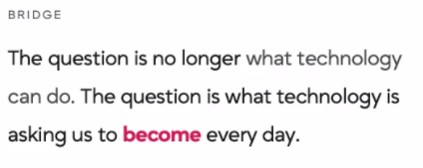
No one is (or has the time/space) talking. Nervous systems need recovery time (sleep, rest, time away). Constant context-shifting causes cognitive saturation.
We have a role as AGENTS – real agents, for not just change, but change of trajectory and discourse. Afterall, WE’RE THE HUMANS (the bosses), for whom the technology should serve. At the risk of swearing, we need to wake up and realise that we are not the B*****s of AI, we are its master. If we are worried about it, we need to change it, “We can’t just criticise the world…” we need to be active agents of pro-human change.
Thank you, thank you, thank you Martina, Sérgio and Jane. What a lovely dish of food for thought.
Rebekah Rousi, SIGCHI Finland